Why Is There Islamic Violence?
What is the connection between Islam and violence? Few ask this
question, that is, among those who still have the right to speak in this
institutionalized world, whether secular or religious. More often than not, this
question is avoided by denying that Islamic tradition and the Koran have actually
justified violence for fourteen-hundred years. Or, the question is drowned in a
flood of platitudes – all those magical calls for peace in which some Muslims
are invited to participate (with sincerity or not, it does not matter) – calls
which change nothing.
First Consideration: The Manipulation of Islamic Violence
All this has been going on for fifty years now, as explained by an ex-Leftist who saw the light – the former journalist, Yves Mamou, who has just published, Le Grand Abandon. Les élites françaises et l’islamisme (“The Great Abandonment: French Elites and Islamism”), in which he lists the various French collaborators with Islam: "In the end, I realized that I had put together a directory of power in France. Almost all the political parties, the great bodies of the State, the justice system, the universities, the experts, the artists and the centers of culture, the media – all were on the side of the Islamists. Even the Catholic Church was alongside the Islamists." Of course, we cannot share Mamou’s conclusion, but his book is very important.
The word, “Islamism,” in the title of the book is chosen by design.
Properly speaking, there really is not an “Islamization” of Europe that we are
witnessing. If that really were the case, as the Algerian blogger, Aldo
Sterone, has observed, then there should be mosques in Europe representing all
the trends and movements within Islam. Rather, what is happening in the West
should be called, “Islamitization,” for despite ethnic or national diversity,
almost all mosques are under the umbrella of the international Islamist
organization known as the Muslim Brotherhood, which is regarded as a terrorist
outfit in several Muslim countries (Egypt, UAE, Saudi Arabia, although this
does not stop Saudi Arabia from funding mosques throughout the world).
All the while, the Muslim Brotherhood is in power in Turkey. The elite media hides the true nature of Islamist totalitarian tyranny in present-day Turkey. Ever since the shoddy attempt to eliminate Erdogan in 2016, 55,000 people have been arrested and 140,000 sacked or suspended; 4,395 judges and prosecutors have been dismissed; 2,281 private institutions closed, including 15 universities; 19 unions suspended and nearly 2,000 people sentenced to life imprisonment. Arrests and convictions continue. Further, the Muslim Brotherhood is perfectly tolerated in the West, actively collaborating with Washington, in particular under former President Obama (and everyone already knows about the deep links of the Bush family with Bin Laden).
In contrast, there is the law signed by President Trump on December 11,
2018, which defines the crimes carried out by jihadists against Christians and
Yazidis, in Iraq and in Syria, as genocide. Such a law now requires the American
government to prosecute the perpetrators of these crimes and authorizes
governmental or private aid to the victims, including Syrians who earlier had
been excluded because of the embargo of 2004 (an embargo which was the first
act of war against the Republic of Syria).
What therefore emerges is a massive collaboration between globalist and
Islamist elites – a collaboration which also excludes all those that oppose
them. How and why?
Briefly (because this is not the decisive aspect of Islamic violence), violence
is a tool for the various powers in place, Muslim or not, who have little
interest in the welfare of populations, only in their subjugation or submission
(which is precisely the meaning of the word, “Islam”). To put it another way, violence
is very useful, especially as terrorism, through which the powers in place come
to dominate civil society. It is not by accident that Western secret services,
and their client states, created and now support jihadist organizations. The
British MI5 brought about the Muslim Brotherhood in the 1920s; the CIA created
the Taliban in Afghanistan, long before the invasion of that country by the
Soviet Union. Then the CIA created Al-Qaeda, then the Islamic State (ISIS, or
Daesh), then Al-Nusra, and so on.
It is not without reason that President Sissi of Egypt warned young people not to be enticed by Islamism when visiting the West: “You want to go there with your culture which you consider non-negotiable. You say, this is who we are and you must accept us as such because of human rights. No. If you visit a country as a guest, you must fully respect its laws, customs, traditions, and culture.” Al-Sissi even defended the right of any country welcoming migrants to "protect its people," while "respecting human rights, in a framework that preserves its national interests." President Al-Sissi was addressing young people at a forum in Sharm el-Sheikh, on December 13, 2018. He knew that the worst jihadist criminals in Syria were the young people indoctrinated in the West (with full complicity of elected politicians).
But people are now catching on and all this is starting to be known and
understood, especially in France, despite the control of the media and
censorship. The uniqueness of France, as a civil society that has not yet been
annihilated, is something that many are waking up to, although it is already
late, no thanks to the Church. In fact, has the Church in the West become so
very incapable of bringing people to God – that Western people now go searching
for God in Islam and other religions?
The phenomenon unfolding before us is this – civil society is
confronted by the ruling elites who want to enslave it (and, in effect, destroy
it). This is the true origin of the spontaneous movement of the Yellow-Vests (the
gilets jaunes). But this phenomenon is not particular to France, or even to the
West – it has arisen in all parts of the world, including in countries where
Islam is the state religion. Such a confrontation is the reason why this civil
movement has been embraced everywhere. Manipulation by the elite is certainly
the initial explanation for the existence of Islamic violence, and its
terroristic aspect.
But this is also not the fundamental explanation – for how is it that
Islamic violence fits so well with some of the games of geostrategic
domination? Why Islam? Or more precisely, why Muslims and Islamists in
particular? Are they better able to be manipulated and used (they certainly are
not alone in that regard)?
The Deciding Factor – The Truncated Hope Of An Ideal World
For answers to these questions, some turn to the Koran, because this book supposedly fell out of the sky. Indeed, if a book advocates violence (at least as a means to an end) and is held to be divine, one faces a huge problem, reaching down into the very bedrock of religious psychology (for what God wants must be done). This is likely the initial response. However, serious Islamologists know that the Koran has a long and complex history. Thus, it is important to understand the historical and cultural context in which this book was fabricated. If violence is advocated and also encouraged (and the Sira, or biography of Muhammad elaborates further: massacres, rapes, robberies, deception and ruses, etc.) – what is its end goal? If the objectives pursued imply the domination of the world and the elimination of everything that is not Islamic (the annihilation of the Other, as Claude Lévy-Strauss said in Tristes tropiques), what is all that for?
Possessing an innate theological sense, ordinary people understand the
ultimate goal, which is to realize on earth a model of the ideal society that
God supposedly wants (which has nothing to do with Plato’s political dreams).
In this model, the will of God is supposedly known by the rulers, personified
by the Khalifa (thanks to the Koran and the Sunnah), who must comply with
divine will and convert the totality of mankind to obey it (down to the
smallest details of daily life), the imposition of Shariah. This is the great
Muslim Cause, the source of Islamic violence.
Below the rulers are the rest of the Muslims (men) , who must be mukallaf, that is, militants, devoted
body and soul to the Cause and always obeying the Khalifa (upon pain of death).
Below the men are Muslim women, who must be subject to men, otherwise the men
risk being diverted from the Cause (see, Koran 64.14, a verse often overlooked).
A Muslim can take a Christian or Jewish woman, but only on the condition that
he control her judiciously. The children of such a union are to be Muslims.
Below the Muslim women are non-Muslims, Jews and Christians, who are provisionally
tolerated. Finally, at the very bottom are the mass of other men, namely, slaves,
or those who must be made invisible (those whose existence is a heavy weight upon
the earth).
Curiously, there is hardly a theologian (Catholic or Protestant) who opposes this radical character of Islamic totalitarian thought, which evokes a pyramidal shape, but which is far more than that. Was it really so very difficult to find this same type of thinking in other ideological systems, by way of historical ties of kinship? At the end of his life, the theologian Henri de Lubac looked at this question in his last book entitled, La postérité spirituelle de Joachim de Flore (The Spiritual Posterity of Joachim de Flore). Of course, Lubac does not speak about Islam; but he does show that the idea of a New Era which is to be built in order to fulfill the will of God on earth is explicit in the West at least since the twelfth century, and that it then led to genocides and modern concentration camps. We know that Joachim de Flore, a true heretic, was considered a saint in Rome by certain cardinals (who willingly saw themselves as ministers of the coming Universal Kingdom). Such a totalitarian idea obviously did not suddenly appear one day out of the blue – it already had in a long history. And it did not appear suddenly in the seventh century with Islam. Where did this fundamentally mistaken idea come from?
This fundamental error took shape at the end of the first century AD,
among ex-Judeo-Christians, who had renounced the teaching of the Apostles. The
error consists in truncating the promises of Revelation – and in particular
those of Jesus when He called Himself the “Son of Man” – promises which concern
the establishment of the reign of God upon the earth, after the Glorious Return of Jesus, and after the “Judgment” uniquely associated with it. And not before.
The difference is crucial – the conditions of life will no longer be the same after. The manifestation of the Coming
or Glorious Presence will bring about a communion of the willing, which renders
any pyramidal system useless (which is only fabricated for coercion).
The way in which human beings will be organized no doubt will be
diverse, each according to condition and ability. Pondering all this should
have been the work of theologians, had theology (Western) not been so
thoroughly damaged by playing with ideas and moral precepts that precisely
sought to bring about a human project, that is, seeking to establish a society
or life which was reminiscent of certain aspects of the pyramidal. This is what
is known as “Augustinism,” a hardened and ideologized form of Augustine’s
thought (mainly at the end of his life), which was developed by the thinkers of
the Middle Ages. It gradually fashioned occidental theology to its ultimate
self-destructive consequences in the twentieth-century. Losing all ability to
question the world (which can only happen if you do not lose sight of the Glorious
Return), such theology fell into empty and nonsensical atheism, which was then polished
up as “spirituality” and good intentions, and which can now no longer be concealed.
You cannot amputate Revelation with impunity.
And the alibi of this amputation lies in the confusion systematically
maintained of what comes “before” the Glorious Return and what comes “after.”
Worse, those who refuse to think about what comes “after” the Glorious Return
are the very same ones who a few years ago announced the coming of universal
socialism and who have now been recycled today as the “multireligious,” which is
just one aspect of multiculturalist ideology, which is supposed to bring peace
on earth.
These successors of Joachim de Flore and of the totalitarianisms of the
twentieth-century are the same ones who admire Islam(ism). This is only
logical. If, in relation to the promises of the Glorious Coming, you replace
the proposition “after” with “before,” you become the propagator (always
sectarian) of any politico-religious ideology pretending to bring about these
promises. Of course, the Magisterium of Rome has condemned these projects of an
ideal society before the Glorious Coming, but it has done so, without the
necessary explanations. If you do not explain the perversion of flipping
“after” to “before,” condemnation serves no purpose whatsoever.
This flipping, moreover, obscures a given of Revelation which (and without understanding it) the Muslims have preserved (alongside the fact that they are waiting for the Coming, but materially not Glorious, of Jesus) – and that given we are speaking of is the question of the Anti-Christ. This is not a point of detail; it goes to the very heart of Revelation and gives it coherence. The question of the anti-Christ has recently been clarified by the theologian Françoise Breynaert, in her learned and impressive book, La Venue glorieuse du Christ: Véritable espérance pour le monde (The Glorious Coming of Christ: True Hope of the World).
In a word, this book speaks of salvation, not so much the narrow
personal future of each person (in the individualist and Augustinian sense of
“I have obtained my salvation and the world can perish”) – but in the sense where
the world itself is called to participate in the glory of the children of God.
This book must be widely read. And this book helps us walk away from
Augustinism, which has amputated the theology of the Latin Church for many long
centuries.
Rediscovering Revelation
At the end of September 2018, the Mission Congress was held in Paris,
which brought together various Christian communities as well as Christian
groups in France (Catholic, with an ecumenical bent). The get-together was
powerful spiritually (as well as in acoustics and sound). On Saturday
afternoon, there was a round-table on Islamic issues, with Samuel Pruvot, a journalist,
who served as president. He was flanked by two brave Muslims who opposed
Islamism (one of them was a municipal councillor), as well as a philosopher.
What the four of them said can be summarized in this way: That the
French nation has great integrating power, which only needs the schools to play
their role (along with all the other institutions), and soon Muslims will be
proud to be French. Anyway, the four of them recognized that their hope (which
might have been meaningful fifty years ago) was disconnected from reality. It
would have been far better if they had not spoiled such a precious coming
together of so many young people and had let these young people to listen to
the Word of God speak about building the future. You cannot better illustrate
the disconnect that exists in the Church between human discourse and one that takes
faith into account.
And above all, if you want to dialogue with Muslims, it is imperative to understand what it is that they have in their heads and in their hearts. Certainly, the hope of the world conforming to the will of God is legitimate, provided it is placed after the Glorious Coming and Judgment Day. Indeed, it is possible to address these issues in the context of the well-known Muslim prayer, the Fatiha (Surah 1 of the Koran). And this necessary dialogue therefore must be done by understanding what lies at the heart of Islamic conviction. Such a dialogue may also address the secular minded, provided that such a mind is even open to such a dialogue. A fifty-page booklet has taken up this challenge (Canevas On the Method of Deradicalization In A Secular Setting Which Also Takes Faith Itself Into Account). It shall certainly inspire others.
For Christians, the will of God has meaning only in an outlook of faith which, on the one hand, views as the starting point the creative act of God, and on the other, the destiny of the created to ultimately enter into His Glory (except those who oppose it, for the Glory of God implies the freedom of His creatures). Therein lies the key. It is this God that Christians have to proclaim to Muslims (and to all men).
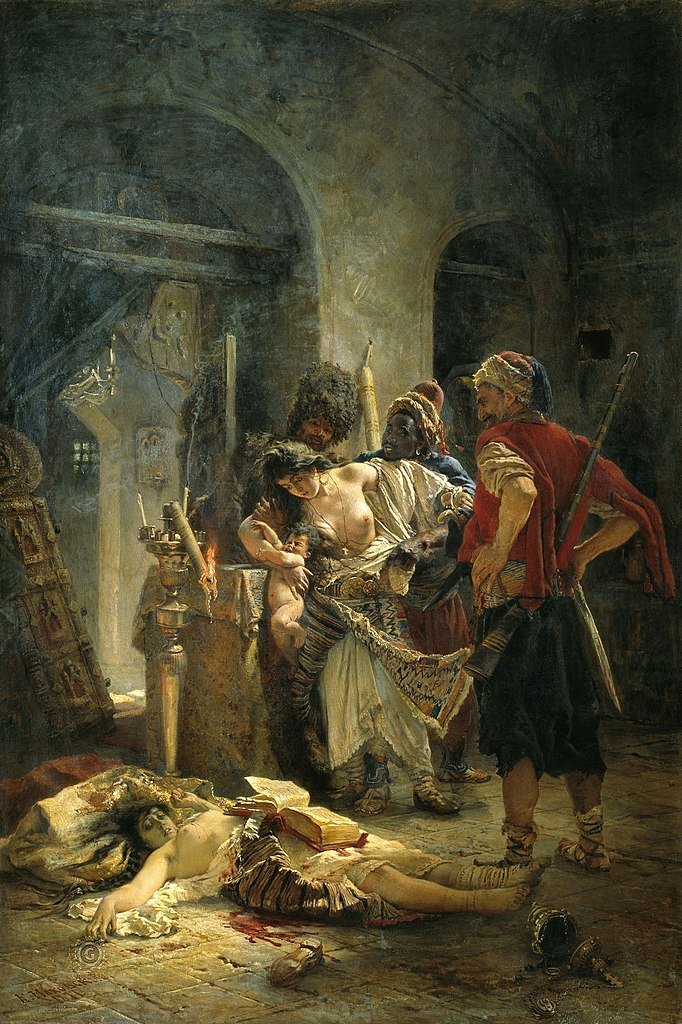
The photo shows, "The Bulgarian Martyresses," by Konstantin Makovsky, painted in 1877.